
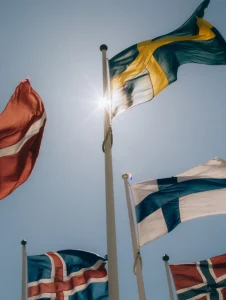
 The Nordic countries are falling in love with Spanish — and the numbers are remarkable.
For decades, the relationship between Northern Europe and Spain has been associated with sunshine, holidays, Mediterranean food and a lifestyle that attracts millions of Scandinavian visitors every year.
But something much deeper is happening.
Inside schools and classrooms across Northern Europe, Spanish has become one of the languages young people are most eager to learn.
The latest education statistics reveal a particularly striking trend.
- In Sweden, one in two pupils in Years 6–9 is studying Spanish.
- In Norway, the number of students learning Spanish has increased by 7.1% over the past five years, while the numbers studying German and French have fallen.
Spanish is making its way north — and a new generation of Europeans is embracing the language.
Sweden: one in two pupils is learning Spanish
Perhaps the most surprising figures come from Sweden.
According to statistics published by Skolverket, the Swedish National Agency for Education, for the 2025/2026 academic year, 50% of pupils in Years 6–9 study Spanish as a modern language.
The gap between Spanish and the other major European languages is striking.
| Language | Share of pupils |
|---|---|
| Spanish | 50% |
| German | approx. 19% |
| French | approx. 14% |
Among female pupils, the proportion choosing Spanish rises to 53%, while among male pupils it stands at 47%.
These figures illustrate just how firmly Spanish has established itself within Swedish education.
Spanish is no longer a niche choice.
It has become the leading modern language studied by Swedish pupils.
Nearly 277,000 people are learning Spanish in Sweden
Figures from the Instituto Cervantes provide an even broader picture.
According to its 2025 Yearbook: Spanish in the World, an estimated 276,948 people are currently learning Spanish in Sweden.
More than 261,000 of them are studying the language within primary education, secondary education or vocational training.
That is an extraordinary figure for a country with a population of around 10.5 million.
And this is not a sudden trend.
For years, Instituto Cervantes has documented the growing popularity of Spanish in Sweden and its increasing strength compared with languages that historically occupied an important position in Northern European education, particularly German and French.
But Sweden is not an isolated case.
The figures from neighbouring Norway tell an equally interesting story.
Norway: Spanish is growing while German and French decline
Official figures from Statistics Norway (SSB) show a particularly significant trend.
In 2025, 68,415 students were learning Spanish within the educational category covered by the Norwegian statistics.
Compare that with the other major languages:
| Language | Students | 5-year trend |
|---|---|---|
| Spanish | 68,415 | +7.1% |
| German | 39,036 | −14.4% |
| French | 18,381 | −15.6% |
Spanish therefore has around 29,000 more students than German and approximately 50,000 more than French within this dataset.
But the most interesting part of the story is what has happened over the past five years.
The number of students learning Spanish has increased by 7.1%.
During the same period:
- German has fallen by 14.4%, and
- French has fallen by 15.6%.
These languages are therefore moving in very different directions.
While the numbers studying two of Europe’s traditionally important foreign languages have declined, Spanish continues to grow.
More than 370,000 Spanish learners in Sweden and Norway
When we look at the broader estimates published by Instituto Cervantes, the scale becomes even clearer.
Its Spanish in the World 2025 report estimates approximately:
- 276,948 Spanish learners in Sweden, and
- 96,450 Spanish learners in Norway.
Together, that represents more than 370,000 people learning Spanish in just these two Nordic countries.
For two countries with a combined population of around 16 million, this is a remarkable level of interest.
It also challenges a common assumption about the international growth of Spanish.
The global appeal of the language is not limited to Spain, Latin America or the United States.
Spanish has also established a powerful presence in some of Europe’s northernmost societies.
Why are Nordic students choosing Spanish?
There is no single explanation.
The popularity of Spanish is likely the result of a combination of educational, cultural, social and economic factors.
But one connection is impossible to ignore.
Spain has a special place in Nordic culture
For generations of Swedes, Norwegians, Danes and Finns, Spain has been one of Europe’s most familiar destinations.
Millions travel to the country regularly, and many return year after year.
The Canary Islands, the Balearic Islands, Andalusia, the Costa del Sol, Alicante and Barcelona have long been among Europe’s best-known holiday destinations.
For many Nordic children, Spain may therefore be one of the first foreign countries they encounter.
They hear Spanish on holidays, in restaurants and hotels, on beaches and in cities.
As a result, Spanish does not necessarily feel like a distant foreign language.
It can already be part of their cultural landscape before they begin learning it at school.
But tourism alone cannot explain what is happening.
Spanish opens the door to far more than Spain
Learning Spanish does not simply allow someone to communicate in Spain.
It provides access to a truly international language.
According to Instituto Cervantes, the global community of potential Spanish users now exceeds 600 million people, when native speakers, people with limited proficiency and Spanish learners are considered together.
Spanish connects Europe with most of Latin America and also has an extraordinarily important presence in the United States.
For a student in Stockholm, Oslo, Copenhagen or Helsinki, learning Spanish can therefore mean being able to communicate in Madrid, Barcelona, Mexico City, Buenos Aires, Bogotá, Lima, Santiago, Miami and countless other places around the world.
That international reach gives Spanish an advantage that extends far beyond holidays.
It can be useful for education, travel, international business and future career opportunities.
Spanish is becoming increasingly important across Europe
The Nordic story is also part of a much wider European trend.
The latest Eurostat figures show the growing importance of Spanish within European education.
In 2023, English remained by far the most commonly studied foreign language among students in general upper secondary education in the European Union.
But behind English came Spanish.
| Language | Share of students |
|---|---|
| English | most studied by far |
| Spanish | 27.1% |
| German | 21.2% |
| French | 20.8% |
27.1% of students were learning Spanish as a foreign language, compared with 21.2% learning German and 20.8% learning French.
That makes Spanish the second most studied foreign language in general upper secondary education across the European Union.
What is happening in Sweden and Norway should therefore not be viewed in isolation.
It is part of a broader change in the languages chosen by younger generations of Europeans.
Finland: a culture built around learning languages
The picture is not identical across every Nordic country, and it is important not to overgeneralise.
Available data does not show Spanish having the same extraordinary position in Finland that it currently enjoys in Sweden and Norway.
However, Finland provides another remarkable statistic.
According to Eurostat, in 2023 97.8% of lower secondary students in Finland were studying two or more foreign languages.
That was the highest percentage in the European Union.
The Nordic countries therefore provide a particularly favourable environment for multilingual education.
And within that culture of language learning, Spanish has found an increasingly important place.
From a holiday language to a language for the future
Perhaps this is the most interesting change of all.
For many years, Spanish could easily be perceived in Northern Europe primarily as the language of sunshine and holidays.
Today, that explanation is no longer enough.
Young people choosing Spanish know they are learning a language they can use across Europe, Latin America and the United States.
Tourism may have helped create familiarity with Spain.
Music, sport, gastronomy, film, television and Spanish and Latin American culture have also brought the language closer to younger generations.
But Spanish has become something much bigger:
a global language of communication, education, culture and international opportunity.
Spanish is challenging the traditional European language map
For much of the twentieth century, French and German occupied privileged positions as foreign languages within many European education systems.
The current figures suggest that this map is changing.
That does not make French or German any less important.
What it does show is that Spanish has emerged as a major choice for a new generation of European language learners.
Sweden is one of the clearest examples.
When around half of pupils in Years 6–9 are studying Spanish, compared with 19% studying German and 14% studying French, we are looking at a significant generational shift.
Norway adds another dimension to the story.
Spanish is not simply ahead in student numbers.
It is continuing to grow while the numbers learning German and French decline.
A new European generation is growing up with Spanish
There is something bigger behind all these statistics.
A generation of Europeans is growing up for whom speaking some Spanish will be increasingly common.
They are learning the language at school, travelling to Spain, taking part in international exchanges, listening to Spanish-language music and consuming Spanish and Latin American culture.
Later, many will use the language at university or in their professional lives.
And this matters.
The more people learn a language, the greater its presence becomes in universities, business, tourism, international relations, media and culture.
The figures coming from Northern Europe are therefore not simply interesting educational statistics.
They tell us something about the future international position of Spanish.
The Nordics love Spain — and increasingly, its language too
The numbers are turning a familiar cultural connection into an educational reality.
Yes, Nordic countries have had a special relationship with Spain for decades.
But something even more interesting is now happening.
New generations do not simply want to visit Spain.
Increasingly, they want to understand it, communicate and speak its language.
- In Sweden, one in two pupils in Years 6–9 studies Spanish.
- In Norway, the number of Spanish students continues to grow while the numbers learning other major European languages have declined.
- And across the European Union, Spanish is now the second most studied foreign language among students in general upper secondary education.
Spanish has travelled north.
And it looks like it is there to stay.
Learn Spanish with Cambridge Institute
Would you like to join the millions of people learning Spanish around the world?
At Cambridge Institute, we have more than 30 years of experience helping international students learn languages and achieve their academic and professional goals.
From Madrid, one of the world’s great Spanish-speaking capitals, we offer Spanish courses for students of different nationalities and levels.
You can learn Spanish in person in Madrid, by live videoconference or online, choosing the learning format that best suits your lifestyle and objectives.
Whether you want to learn Spanish to study in Spain, work internationally, travel, prepare for an official qualification or simply speak with greater confidence, our academic team can help you find the right programme.
Ready to start learning Spanish?
Request information with no obligation and our team will help you choose the course and level that best suit your goals.
Spanish is being spoken and studied further than ever before. Start speaking it too.


Acerca de Cambridge Institute
Cambridge Institute es un centro educativo privado líder en formación de idiomas, especializado en la enseñanza de inglés, español para extranjeros, francés, alemán y chino, tanto en modalidad presencial como online.
Con más de 250.000 alumnos formados, se ha consolidado como una referencia en cursos de idiomas online y presenciales, gracias a una metodología innovadora centrada en el alumno, que garantiza un aprendizaje eficaz, flexible y adaptado a las necesidades actuales.
Su enfoque combina profesores especializados, tecnología educativa y programas personalizados, permitiendo a estudiantes de cualquier edad y nivel alcanzar sus objetivos académicos y profesionales.
Además, Cambridge Institute es Centro Examinador Oficial de Cambridge English (Universidad de Cambridge), con un alto porcentaje de aprobados, lo que avala la calidad de su formación y la preparación de sus alumnos para obtener certificaciones oficiales.
